You wake up on Tuesday morning, open Meta Events Manager, and notice your Purchase EMQ score dropped from 8.4 to 4.1.
You check Slack. No engineers shipped code overnight. Your ad spend is running normally. But under the hood, Meta’s algorithm is optimizing campaigns against a signal it no longer trusts — and your CPA is about to reflect that.
If you’ve lived through that morning, this is for you.
Event Match Quality (EMQ) is Meta’s 0 to 10 score for how reliably your conversion events link back to real Meta user profiles. Above 6, the algorithm has a signal it can act on. Below 6, it’s optimizing on noise, and you feel that in your CPA long before you notice it in your dashboard. A browser-pixel-only setup usually caps around 3 to 5. Anything higher requires Conversions API (CAPI) to step in.
This post is a practical diagnostic playbook. We will cover what realistic benchmarks look like in 2026, why your score dropped, how to move every event to 8+, and the part most teams skip — how to keep it there.
What is a good Meta EMQ score in 2026?
Meta’s shorthand is simple: 6 is Good, 8 is Great. That’s the floor and the aspiration. But treating every event the same is a fast way to chase a score you will never reach.
Different events have structural ceilings. A PageView will almost never match the EMQ of a Purchase because anonymous visitors don’t leave phone numbers or email addresses on landing.
The score bands
| Band | EMQ range | What it means |
|---|---|---|
| Poor | Below 4 | Meta can barely match your events. Optimization is guessing. |
| OK | 4 – 5.9 | The signal exists but is noisy. You’ll see it in unstable CPA. |
| Good | 6 – 7.9 | Floor for reliable optimization. Fine for most events, weak for Purchase. |
| Great | 8 – 8.9 | The target for high-intent events. |
| Elite | 9+ | Well-instrumented CAPI + hashed PII on every event + clean dedup. |
Per-event benchmarks
Stop trying to get a 9.0 on every single event. Aim for these realistic target ranges:
- Purchase — 8.8 to 9.3. This is the score that matters most; it drives the optimization the algorithm actually cares about.
- AddToCart — 8.0 or higher.
- InitiateCheckout — 7.0 or higher.
- Lead / Form Submission — 7.0 or higher.
- PageView — 6.5 to 7.5. Lower is structurally normal. If you’re chasing a PageView EMQ of 9, you’re going to hurt yourself for nothing.
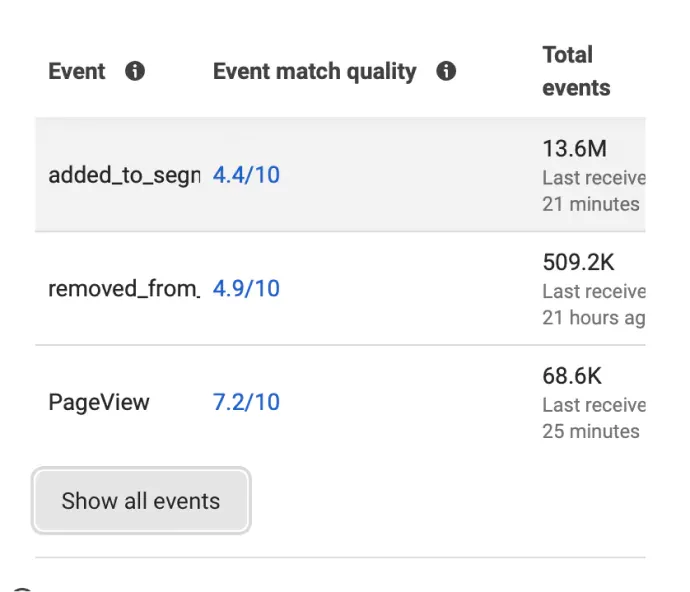
How Meta calculates EMQ (and what actually moves the number)
Meta doesn’t publish the exact formula, but the operator reality is well understood. Meta looks at three things: what identifiers you sent, how many of them cleanly resolve to a Meta profile, and whether your browser events and server events agree via a shared event_id.
Below is the example of how the event match quality is calculated by Meta and the suggestions it gives:
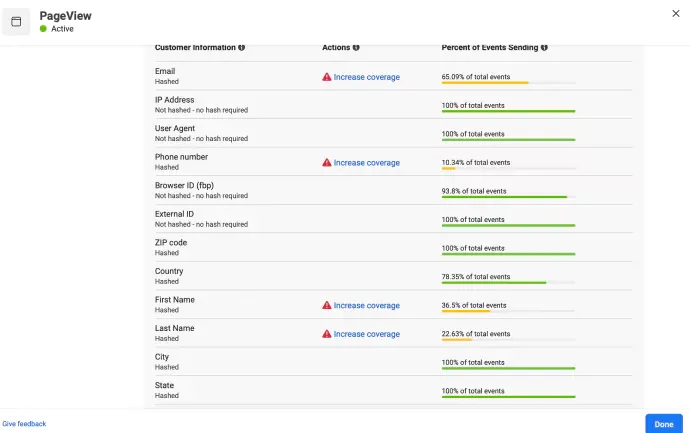
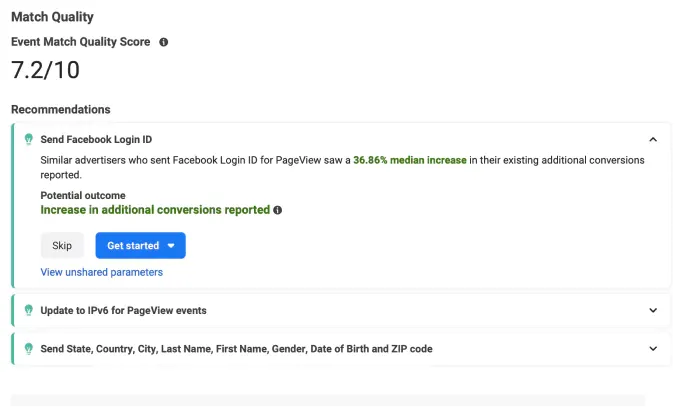
Some parameters move the score far more than others. If you only remember one thing from this section, remember the order.
The parameters, ranked by EMQ impact
- fbc — the Facebook Click ID. Missing
fbcis the single most common reason for scores stuck in the 3.0–4.5 band. It carries the ad-click context that lets Meta connect the server event back to the specific ad interaction, not just the profile. - fbp — the Facebook Browser ID cookie. Ride-along essential.
- Hashed email (em) — the foundation of Advanced Matching.
- Hashed phone (ph) — the biggest single lift after email.
- Hashed first name / last name (fn, ln).
- Hashed city / state / zip / country (ct, st, zp, country).
- external_id — your first-party user identifier.
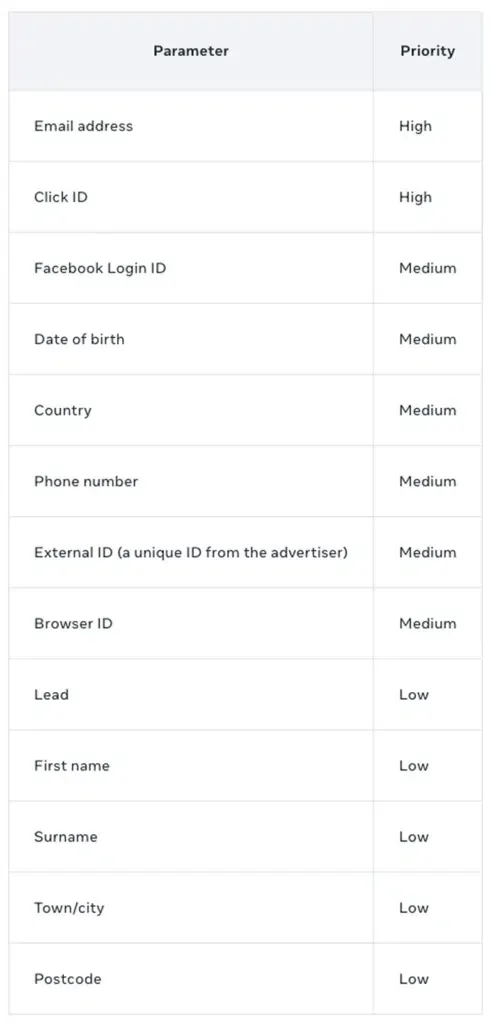
For more detailed information, please refer to Meta’s official documentation on customer information parameters.
The parameter operators keep skipping: external_id
Most CAPI implementations stop at the standard PII fields and never send external_id. That’s a mistake worth fixing.
external_id is your internal identifier for the user — a hashed CRM ID, a hashed logged-in user ID, a hashed customer number, anything stable that you assign and control. It doesn’t have to be an email or phone. It just has to be consistent for the same person across every event you send.
Two reasons it moves EMQ more than most operators expect:
- It gives Meta a stable identity even when PII changes. A shopper who checks out as a guest today with [email protected] and next week with [email protected] looks like two people to a match layer relying only on hashed email. If you attach the same hashed
external_idon both events, Meta can stitch them into one user. That stitched identity is what lifts Purchase EMQ into the 9s. - It survives the sessions where PII isn’t available. A logged-in user browsing on a fresh device or an incognito window won’t have
emorphin the data layer. If your app knows who they are, you can still stampexternal_idon their ViewContent and ATC events. That’s often the difference between a PageView EMQ of 5 and one of 7.
Hash external_id with SHA-256 just like the other PII fields. It should be a value that means nothing to anyone outside your system — never send a raw email address or a raw phone number as external_id. If your CRM identifier is already a UUID or an internal customer number, hash it and send it. If your user ID is an email under the hood, hash it as an email in em and hash a separate internal ID as external_id.
CustomerLabs identity resolution handles the external_id mapping automatically — one profile per person, one stable hashed identifier across every event.
What to hash and what not to
Hash every PII field above with SHA-256. Lowercase the input, trim whitespace, strip punctuation. For phone: digits only, include the country code, no leading +. For email: lowercase, trim, that’s it.
Do not hash fbp, fbc, IP address, or user agent. Meta expects those raw. Hashing them will silently degrade the score because Meta can’t parse what it thinks it’s reading.
Deduplication with event_id
If you’re running the browser Pixel and CAPI in parallel — which you should be — every matched event pair needs the same event_id. Meta dedupes events sharing an event_id within a 48-hour window. Same ID = one event counted, and both signals fused for scoring. Mismatched IDs = the same conversion counted twice, and an EMQ penalty, because Meta sees two events with overlapping identifiers it can’t reconcile.
This is one of those things where the default assumption (“more data is better”) is actively wrong. Duplicate events with mismatched IDs hurt you.
Why does FB EMQ drop to Poor or OK?
An overnight EMQ drop almost always has a cause you can find within an hour, if you know what to look for. Here are the five patterns, ranked by how often they turn out to be the answer.
- The post-deploy regression. Something shipped — a GTM change, a DataLayer variable rename, a new consent banner, a server-container tag update, or a Shopify theme edit. This is the #1 reason EMQ falls overnight while event volume looks totally normal.
- Shopify or native integration outages. Meta apps and plugins get logged out during platform updates quietly. There is no error banner or red notification — just an EMQ score that drifts downward while ad spend continues at scale.
- Consent-banner regressions. A CMP update or stricter regional policy stops PII from flowing into the DataLayer for non-consented users. Events still fire, but without the identifiers.
- Volume and audience drift. Scaling paid traffic into low-intent audiences or running promos for guest traffic lowers your match density on AddToCart and InitiateCheckout.
- Real 48-hour noise. EMQ recalculates on a rolling window. A single-day dip in the middle of a stable trend line is statistical noise. A two-day drop is an incident.
Can you trust Meta’s Event Match Quality score?
Yes. Where you must trust EMQ is when it drops suddenly. A sudden drop from 8.5 to 4.0 is Meta’s early-warning indicator that your tracking pipeline is leaking parameters. When that happens, walk through the diagnostic flow below to find the break.
The diagnostic flow
When the drop looks real, walk this in order. Most incidents resolve at step 3.
- Two-day trailing average, not one-day. If it recovers on its own by day three, it was noise.
- Open Events Manager → dataset → Diagnostics. Note which events lost EMQ and which specific parameters got flagged. Meta usually names the problem before EMQ does.
- Check the deploy log for the affected window. Any GTM, data-layer, consent, tag, or native-app change in the 48 hours before the drop is your top suspect. If something shipped, revert it in a staging environment and re-check.
- Open GTM Preview. Fire a test event through browser and server. Confirm PII is reaching the server container and is hashed before egress. This is where “it looks like it’s working” often turns out not to be.
- Send a Test Event with a known
event_id. Confirm dedup fires cleanly. Confirm no parameters get flagged. - Check every native integration for auth state. Shopify Meta app, headless CMS Meta module, plugin auth. If a platform update ran recently, assume something silently logged out until proven otherwise.
- Compare regions. A regional-only drop points to consent, not to a data pipeline break.
If you get to step 7 and the score still looks wrong, you’re probably dealing with something structural — an identifier that was never being collected in the first place, or a category of user (unauthenticated, ad-blocked) growing as a share of total traffic. That’s a strategy conversation, not a fix.
How to get every event to 8+
Once you’ve stopped the bleeding, the path from 6 to 8+ is mechanical. Five things, done consistently.
1. Dual-track Pixel + CAPI with a shared event_id
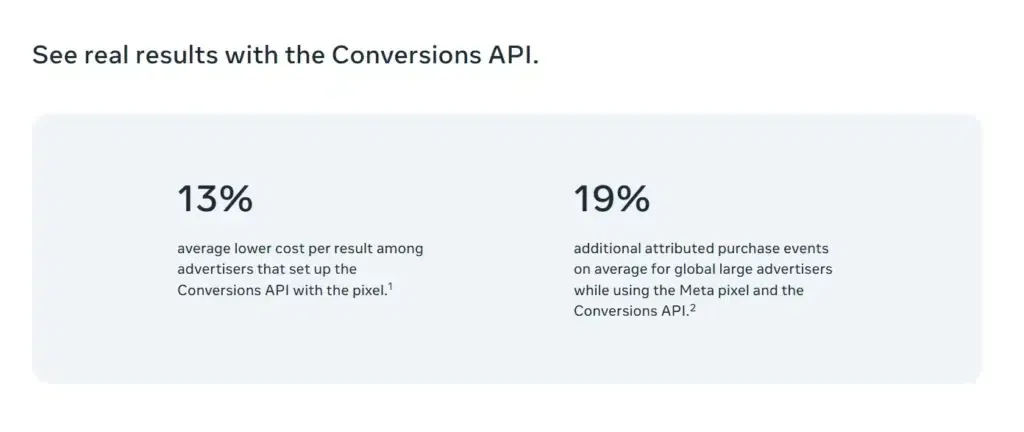
Fire the browser Pixel and CAPI event for the same user action, stamped with the same event_id. Pixel-only sits around EMQ 3 – 5; CAPI-only misses browser-side signals used for fbp / fbc recovery. Fusing both streams yields the highest score.
2. Send hashed PII on every event, not just Purchase
Attach em and ph to ViewContent, AddToCart, and InitiateCheckout. If a user ever provided an email — newsletter opt-in, account login, or checkout field entry — persist that identity and attach it across all subsequent events in that session. Our first-party data guide for EMQ covers the identity-capture patterns for this in more detail.
3. Forward fbc and fbp on every server event, unhashed
Capture fbc from the fbclid URL parameter on landing, store it in a first-party cookie, and read that cookie at server-event time. Forward both fbc and fbp as-is.
4. Move collection server-side
Moving collection to a server container with a first-party domain prevents ad-blockers and browser cookie limits from eating identifiers before Meta ever sees them.
5. Capture identity early, reuse it, and send external_id
Push user details into the DataLayer the moment they enter a form or log in. Stamp a SHA-256 hashed external_id across all events so Meta can stitch sessions even when standard PII isn’t present in the DataLayer.
Monitoring — how to stay above 8
Getting to 8+ is a project. Staying there is a habit. Three practices are enough.
Set an alert at EMQ < 7. Any dataset that drops below 7 gets flagged as an incident. A weekly manual check catches most regressions, but if you have engineering time, polling Meta’s Dataset Quality API on a schedule is more reliable. The alert only helps if someone reads it.
Check EMQ after every deployment. Every change to the frontend data layer, the server container, the consent banner, or any native Meta integration gets a post-deploy EMQ check within 24 hours. This is the single change most likely to catch a regression before it costs you a week of ad spend.
Read the Diagnostics tab weekly. Meta surfaces specific parameter-level warnings — “Missing fbc on 30% of events,” “Hash mismatch on em,” “Duplicate event_id across streams” — before those warnings show up in the composite EMQ score. Reading Diagnostics is like reading a build log: boring until it isn’t.
One emerging pattern worth naming: filtered CAPI. The idea is to filter bot traffic and low-quality events before they reach Meta, so the learning system isn’t scoring events that were never real users to begin with. It’s not default practice yet, but the operators pushing scores from 8+ to 9+ are the ones thinking about signal purity, not just signal volume.
Meta’s Dataset Quality API is where the definitive numbers live if you want to build monitoring against something official.
Conclusion
EMQ has a direct impact on conversions. And the data you send has a direct impact on EMQ.
To conclude, instead of compromising on your conversions, implement effective tools like a 1PD Ops setup to increase the EMQ (event match quality) score in Facebook. The setup includes proper pixel setup with manual advanced matching turned on and Conversions API to give Facebook the complete picture of the user through the events.
CustomerLabs 1PD Ops helps you improve your event match quality and boost your ad campaign performance with the help of first-party data.
So, what are you waiting for? Get your event match quality to at least 6 and more by sending more data effectively to Meta’s ad platform.
Get started with the setup for free or pick a slot for a free consultation call with our experts.