After Meta rolled out restrictions on ad campaigns to be HIPAA compliant, we marketers had one single focus on one thing; get the data and don’t get blocked.
We handle clients’ like hospitals, clinics, wellness & fitness brands. And to all of these businesses, new customer acquisition has always been the deal.
After HIPAA, we started using Jotform HIPAA forms to collect patient data securely and use Meta Ads to bring in new patients.
Because if we don’t send complaint data then we are gonna probably end up getting blocked.
And with our website, Jotform, Meta, CRM, offline visits, somewhere everything breaks.
This blog is about how health brands can use Jotform HIPAA forms effectively to scale Meta campaigns by fixing the data path the right way, not the risky way.
A Simple Scenario: Where Jotform HIPAA Meets Meta Ads (and Things Start to Crack)
You’re running Meta Ads for a healthcare brand.
A user clicks your ad, lands on your page and fills a form ( HIPAA Jotform) to book a consultation.
Inside Jotform? Everything is perfect.
Data is encrypted. PHI is protected. HIPAA compliance stays intact.
Till now comes, Zero issue and everything goes as per the expectation.
Now comes the attribution part. Meta needs a conversion signal to understand two things:
-
Which ad drove a lead
-
Who to optimize for next
So normally, when a form is submitted, we send a “Lead Generated” event to Meta Ads
so Meta knows which ad worked.
But Jotform HIPAA forms do not send conversion events to Meta by default.
And even if we try to connect it directly; the form contains PHI, and sending this event as it is would violate HIPAA
The biggest problem here is:
Jotform collects the lead, but Meta knows nothing about it. Because there is no HIPAA-safe way for the conversion signal to travel from Jotform to Meta.
Not using Jotform is not the fix here. The real fix is not choosing one over the other.
It is fixing the missing data path between them.
How Do We Fix the Data Gap Between Jotform and Meta Ads?
At this point, the problem is clear.
-
Jotform HIPAA does exactly what it should - protect patient data
-
Meta Ads do exactly what they should - optimize only when signals exist
The gap is the missing, HIPAA-safe conversion signal
The only real way forward is this:
We need a compliant data layer that bridges Jotform & Meta to send patient data.
A system that:
-
Listens to Jotform submissions
-
Strips out PHI completely
-
Converts them into privacy-safe events
-
Sends only compliant signals to Meta using server-side tracking
Such system is already built and ready to be used,
How CustomerLabs Bridge the Data Path Between HIPAA Jotform and Meta?
CustomerLabs doesn’t replace Jotform. It respects what Jotform is built to do
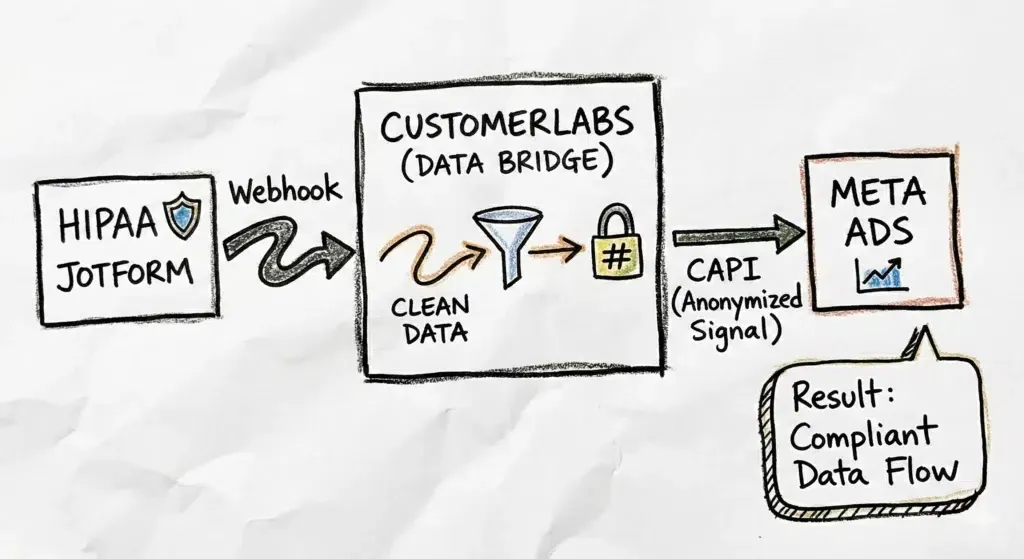
In simple terms, CustomerLabs becomes the missing layer between HIPAA-secure Jotform submissions and performance-driven Meta campaigns. A privacy-first data bridge designed specifically for health, wellness, and medical advertisers.
1. Easy Integration With Jotform and Your Entire Stack
For most marketing teams, integrations usually sound painful endless configs, dev dependency, and trial-and-error setups.
You shouldn’t need a developer every time when you just need to set up something
CustomerLabs keeps it straightforward.
-
Connect Jotform using a webhook
-
Connect your website, CRM, landing pages, backend, or scheduling tools
-
Define and map events using a no-code interface
CustomerLabs becomes the central hub where Jotform submissions and user interactions flow in a clean, structured, and consistent way without technical complexity.
2. Reliable Server-Side Tracking With Meta CAPI
For health and wellness advertisers, relying on the Meta Pixel is risky. Browser-based tracking can unintentionally expose sensitive data.
CustomerLabs solves this by shifting all critical tracking to server-side using Meta’s Conversions API (CAPI).
-
No browser leaks or accidental data sharing
-
Full control from a no-code dashboard
-
Bottom-funnel events can be activated safely and compliantly
This rebuilds Meta’s feedback loop allowing campaigns to optimize properly without exposing any patient information.
3. Automatic HIPAA Filters That Remove All Sensitive Data
This is where CustomerLabs is purpose-built for healthcare use cases.
Automatically filter out the health info before it even reaches Meta, sending only what is required by Meta. Nothing more, Nothing Less.
Before any event reaches Meta, CustomerLabs applies multiple layers of HIPAA-safe filtering:
-
PHI removal – any data that could indicate identity or condition is stripped
-
PII hashing – emails, phone numbers, and identifiers are hashed using SHA-256
-
URL cleanup – sensitive paths like /diabetes-consultation are removed
-
Event neutralization – descriptive event names are converted into generic ones
Only compliant, privacy-safe signals are passed to Meta nothing more.
4. Sending Clean, HIPAA-Safe Conversion Events to Meta
Once the data is sanitized and neutralized, CustomerLabs sends the event to Meta via CAPI.
Meta receives:
-
A valid conversion event
-
Approved, privacy-safe parameters
-
No restricted health context
As a result, Meta understands which users convert, learning resumes, and campaign performance stabilizes all while staying compliant with HIPAA and Meta’s health policies.
This setup is not limited to Meta alone. CustomerLabs can send compliant events to other ad platforms as well.
CustomerLabs doesn’t just connect Jotform to Meta. It repairs the entire data pipeline that feeds Meta.
How a Health Brand Scaled Meta Ads Using Jotform HIPAA and CustomerLabs
A healthcare brand running Meta Ads moved all patient intake and consultation bookings to Jotform HIPAA forms to stay compliant with Health & Wellness policies.
From a compliance point of view, everything worked as expected. Patient data stayed encrypted, PHI was protected, and Jotform did exactly what it was supposed to do.
But performance took a hit.
“Jotform was securely collecting the user data but we weren’t able to get this data back to ad platforms without getting blocked. It happened once earlier.”
Once the switch to Jotform HIPAA happened, Meta stopped receiving reliable conversion signals. Bottom-funnel lead events didn’t reach Meta and campaigns optimize poorly.
They said:
“We had all the good leads inside our CRM, but it’s not moving anywhere.”
To fix this, the brand connected Jotform HIPAA with CustomerLabs to rebuild the data path without exposing any PHI.
Jotform continued as the secure intake layer, while CustomerLabs captured form submissions as privacy-safe events. Sensitive data was stripped or hashed, URLs were neutralized, and clean server-side conversion events were sent to Meta using CAPI.
Once Meta started receiving compliant signals again, campaigns stabilized. EMQ improved, cost per lead dropped by 60–67%, and conversion rates increased by 42% all while remaining fully HIPAA compliant.
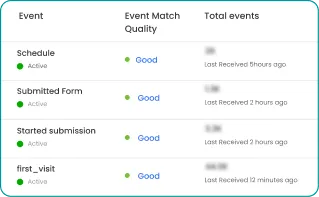
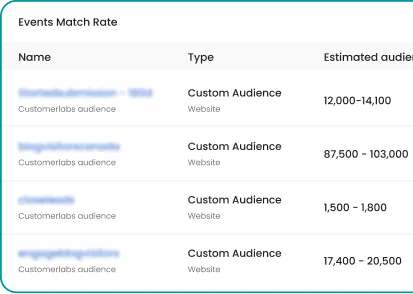
This setup allowed the brand to scale Meta Ads without choosing between privacy and performance.
Next, let’s look at a quick setup guide that they implemented end-to-end.

Easy Guide to integrate Jotform with CustomerLabs
Step 1: Connect Jotform to CustomerLabs
“The bottom funnel events data were sent back to the ad platform without calling oyt names like weight loss, diabetes, heart patient.”
-
Go to your form in Jotform
-
Open Settings → Integrations → Webhooks
-
Add a new Webhook URL
-
Paste the CustomerLabs Source URL from your CustomerLabs dashboard
-
Save the integration
Now, every time a form is submitted, Jotform sends a de-identified event signal to CustomerLabs (without PHI).
Step 2: Connect CustomerLabs to Meta
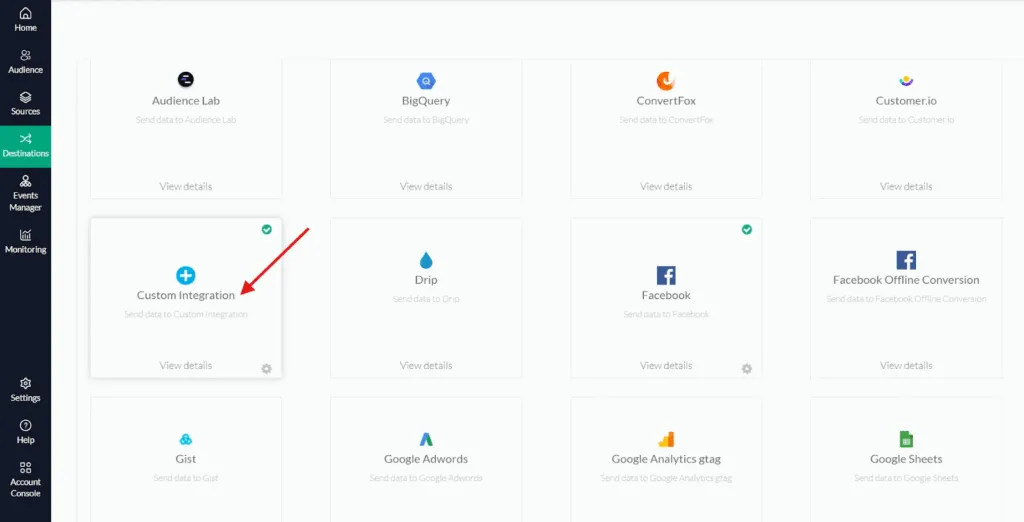
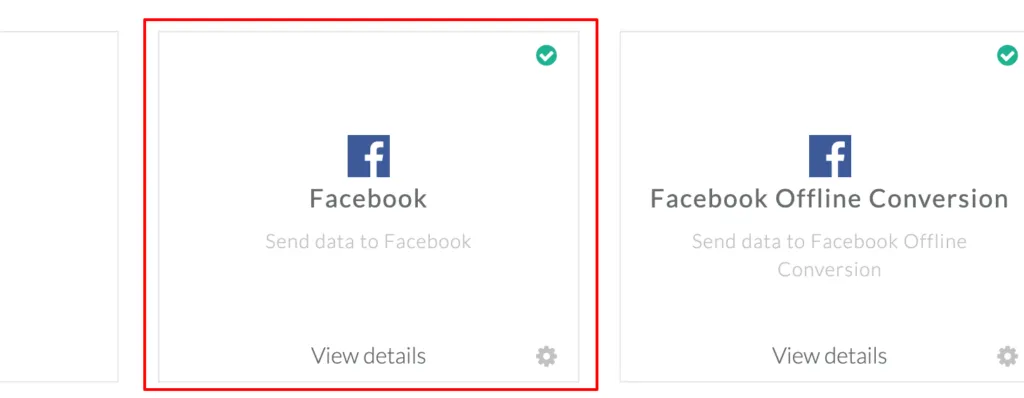
- Open Destinations → Meta (Facebook)
-
Add your Pixel ID and Access Token
-
Turn ON Server-Side Events (CAPI) and Turn off browser events
-
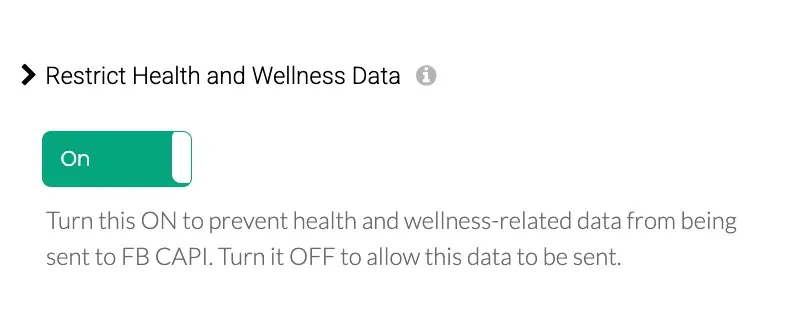
Toggle on Restrict Health and Wellness Data
“One toggle button, acts like a filter paper, filtering out the PHI (health info along with the identity)”
-
Choose which events to send (e.g., lead_generated)
-
Test using Meta’s Event Test Tool
Refer this official Jotform CustomerLabs integration docs for more detailed steps. Just in minutes we have successfully set up the entire data pipeline from Jotform to Meta.
How the Jotform and CustomerLabs Setup Improves Meta Ad Performance? (But not limited too)
-
Tracks every Jotform HIPAA form submission using server-side tracking and keeps the entire tracking workflow fully HIPAA compliant
-
Automatically removes PHI and hashes PII before data reaches Meta
-
Cleans sensitive URLs and neutralizes health-related event parameters
-
Sends clean, compliant conversion events to Meta via Conversions API (CAPI)
-
Restores Meta’s learning loop with consistent, bottom-funnel signals
-
Improves Event Match Quality (EMQ) for Meta Ads optimization
-
Enables accurate audience targeting and reduces cost per acquisition (CPA)
You can benefit a lot from CustomerLabs. If you have any specific use case in mind, opt for a free consultation call now or you can even implement the setup yourself using the 14-day free trial.