Most marketers using HubSpot have a similar understanding of tracking.
A visitor clicks an ad, lands on the website, fills out a form, becomes a lead in HubSpot, and eventually turns into a customer.
HubSpot records the journey. Advertising platforms receive conversion data. Reports show which campaigns generated leads and revenue.
Everything appears connected.
In fact, many businesses assume that once HubSpot is integrated with Meta, Google Ads, or LinkedIn, the advertising platforms have all the information they need to optimize campaigns effectively.
But that’s not how modern advertising works.
HubSpot is excellent at managing customer records and syncing CRM milestones. However, today’s ad platforms optimize on far more than CRM milestones. They learn from behavioral signals, customer intent, and identity data generated throughout the customer journey.
The shift is that much of that information never reaches the ad platforms.
Someone might visit your pricing page three times, compare multiple products, watch a demo video, download a brochure, and return from different channels before ever submitting a form.
Those actions often reveal more buying intent than the eventual form submission itself.
Yet in many tracking setups, the advertising platform never sees them.
This creates a gap between what your CRM knows and what your advertising algorithms know.
And as browser-based tracking becomes less reliable, that gap becomes increasingly expensive.
That’s why marketers are investing in first-party data strategies that go beyond CRM synchronization.
Before we look at the solution, let’s first understand what HubSpot already does well.
What HubSpot Tracking Does Well
HubSpot has become one of the most widely adopted CRM platforms because it helps marketing and sales teams manage customer relationships in one place.
I want to be fair here, because HubSpot is excellent at what it’s built for.
If you’re a B2B team, a B2C brand, a real estate firm, a coach, or an agency, HubSpot is probably the spine of your operation - forms, funnels, lifecycle management, the CRM your sales team actually lives in.
And to its credit, HubSpot doesn’t just store that data. It pushes key milestones back to the ad platforms:
- CRM lifecycle stage sync - when a contact moves to MQL, SQL, opportunity or Customer, HubSpot can send that event to your ad accounts.
- Form submission sync - HubSpot form fills can be passed through as conversion events.
- Platform support across Meta, Google, and LinkedIn integrations - it connects to Meta’s Conversions API, Google’s Enhanced Conversions for Leads, and LinkedIn’s Conversions API.
Why does this matter?
Because it closes one important loop: it tells the ad platforms “this lead became a customer.” That’s the real value. Before this existed, a lot of teams were flying completely blind on what happened after the click.
So no - this isn’t a “HubSpot is bad” post. HubSpot is great at managing CRM data and syncing lifecycle milestones.
Here’s what most brands miss, though.
Modern advertising platforms don’t just optimize on outcomes.
They optimize on signals.
And that’s where the limitations begin.
The Limitation: CRM Milestones Are Not the Full Customer Journey
Syncing CRM milestones answers one question: “what stage is this contact in?” But that’s a handful of snapshots. The customer journey is a movie, and HubSpot is sending the ad platforms a few still frames.
Let’s look at where it falls short:
Lifecycle stages are limited
They fire at big, discrete moments - MQL, SQL, Customer. Useful, but coarse. The algorithm is learning from a half-dozen labels, not from behavior.
Most marketers assume that if Meta knows who became a customer, that’s enough information for optimization.
But a lifecycle stage is a business outcome.
It is not a behavioral signal.
Inside HubSpot, all may eventually reach the same lifecycle stage.
To the CRM, they look similar.
To an advertising algorithm, they are completely different.
The behavioral journey that predicted the conversion is often more valuable than the final lifecycle label itself.
A lifecycle stage update simply tells the platform:
“Contact 1234 became an SQL.”
It doesn’t explain:
- Which pages were viewed
- How many sessions occurred
- Which content influenced the decision
- Which interactions predicted conversion
As a result, advertising platforms learn from outcomes while missing much of the behavior that created those outcomes.
Form submissions happen late
A form fill is often the last thing a person does after days or weeks of research.
By the time it fires, all the high-intent browsing that predicted the conversion is already lost. And there are real mechanical limits too - HubSpot can only sync conversions from forms you built in HubSpot; non-HubSpot form submissions don’t make it to Meta at all.
Many tracking strategies revolve around form submissions.
Yet the form submission often becomes the first meaningful signal that reaches the advertising platform.
If everything that happened before remains largely invisible, then this creates a significant optimization delay.
So this may lead to many valuable learning opportunities having already been lost.
Custom events aren’t naturally ad-ready
When HubSpot records a custom event, it’s writing a note in your own diary: “This contact viewed the pricing page on Tuesday.” But it lives inside HubSpot, attached to a contact record you already know about.
The ad platform never sees it - and even if it did, it couldn’t do anything with a diary entry. Meta doesn’t know who the particular contact is.
What Meta and Google actually need is a different thing entirely. It needs that event along with identifiers such as:
Email, Phone number, click ID (fbclid, gclid), Browser identifiers,
So that it can match the event back to a real user.
Without those identifiers, the event helps your team understand customer behavior, but it doesn’t help the algorithm learn from it.
So there are really two completely different jobs hiding behind the words “custom event”:
- Storing the event - logging “Sarah did purchase” in the CRM for your records and reporting. Bookkeeping.
- Activating the event - sending “Sarah did purchase, and here’s everything you need to match them to a real human” to the ad platform, ready to act on. Fuel for the algorithm.
HubSpot is built for the first job. It’s a CRM - bookkeeping is the point.
Modern ad optimization runs entirely on the second, and that’s the job no CRM was designed to do.
That’s why a custom event sitting inside your CRM is not automatically an ad-ready conversion signal.
Tracking the event is one job.
Activating the event for optimization is another.
And that’s the gap many marketers don’t realize exists.
Anonymous behavior is missed
This is often the largest tracking gap. HubSpot’s native visitor tracking is largely company/IP-level - it stops at the company level for individuals.
So the entire anonymous phase - the part where someone is circling your offer, comparing, coming back three times - is invisible until they hand over an email.
And here’s the platform-specific reality nobody warns you about:
- LinkedIn only syncs lifecycle stage changes - not form submissions - and only counts conversions within 90 days of the ad click. A deal that closes on day 120 simply doesn’t exist on LinkedIn.
- Google won’t sync form-submission conversion events if you’re on a Manager (MCC) account.
- Meta only counts events created after you set up the conversion event - and only from HubSpot forms.
This is like fixing the mirror when the engine is broken. The dashboard reflects something tidy. The machine underneath is running on a fraction of the data.

Why this quietly wrecks your bidding
Here’s the consequence most people never connect the dots on, and it’s the real cost: journey-aware bidding.
Meta and Google don’t just record conversions - they bid in real time on who to show your ad to next, and they decide based on the signals you feed them. When the only thing you send is a late milestone like “became a customer,” the algorithm is bidding almost blind. It can’t tell the difference between someone who watched your demo, came back twice, and read your pricing page - and someone who bounced in four seconds. To the platform, both are just “a lead,” and it bids the same for the lookalikes of both.
Now feed it the journey instead. “Viewed pricing.” “Came back from a Google search.” “Watched the demo.” “Then closed.”
Suddenly the algorithm can see the shape of a path that leads to revenue - and it starts spending your budget chasing people who behave like your closers, not people who behave like your bouncers.
That’s journey-aware bidding: the platform optimizing toward the trajectory of a high-value customer, not a single end-state checkbox.
You can’t get there by sending more milestones. You get there by sending the journey - every meaningful event, enriched and matched, in the order it happened.
Which leads straight to the thing that makes a journey in the first place. Because a string of events only becomes a path if you know they all belong to the same person. And stitching them to one person is exactly where things get messy - it’s a problem of identity.
Why Identity Resolution Becomes Critical
Identity Resolution answers: “Who is this visitor?”
Identity Stitching answers: “How do all of these interactions belong to the same person?”
Think about how a real customer actually behaves.
They show up anonymous from a Meta ad. They leave. They came back two weeks later from a Google search. They read three pages. They leave again. Then they fill a form. Then, a month later, they close.
If you can’t stitch those moments into one person, you’re handing the ad platforms a pile of disconnected fragments. Identity resolution is what turns the fragments back into a human:
- Anonymous-to-known journey - connect the browsing that happened before the form fill to the contact it eventually became.
- Cross-session stitching - link that Meta visit, the Google visit, and the final conversion into a single path.
- Better match quality - more matchable parameters per event means a higher match rate, which means the algorithm actually finds the person.
- Stronger retargeting and suppression - target the high-value lookalikes of people who closed, and suppress the ones who already bought.
Without identity resolution, “send conversions to Meta” is just sending noise with a label on it. With it, you’re sending the platform a real customer story.
So what actually does this work? Not the CRM. A first-party data layer.
Why Every Ad Platform Is Pushing First-Party Data
If you’ve spent any time reading Meta, Google, or LinkedIn documentation recently, you’ve probably noticed a common theme.
Meta repeatedly recommends businesses implement Conversions API and improve signal quality because browser-based tracking is becoming less reliable.
Google’s Enhanced Conversions documentation emphasizes the importance of first-party customer data for improving measurement and bidding.
LinkedIn’s Conversions API documentation highlights server-side first-party data as a way to improve attribution and campaign performance.
The industry’s direction is clear. Platforms are moving away from third-party identifiers and relying increasingly on first-party customer data for measurement, attribution, audience building, and campaign optimization.
What a First-Party Data Layer Actually Does
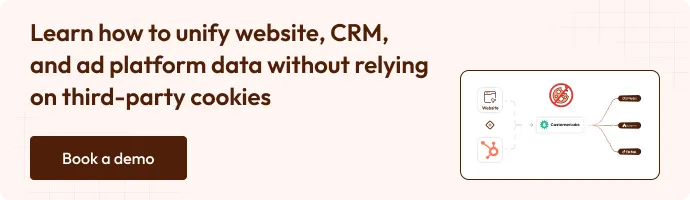
A first-party data layer sits underneath your CRM and your ad platforms and does five jobs the CRM was never designed to do:
- Capture - collect behavioral events from both anonymous and known visitors, server-side, before iOS, ITP, or ad blockers can strip them away.
- Resolve - stitch anonymous sessions to known contacts the moment identity is revealed, so the pre-form browsing isn’t thrown away.
- Enrich - attach the matching parameters to every event: hashed email, phone, click IDs (fbclid/gclid), browser ID, IP, user agent.
- Segment - build audience cohorts from real behavioral signals, not just static lifecycle stages.
- Activate - push identity-matched, server-side events to Meta CAPI, Google Ads Enhanced Conversions, and LinkedIn CAPI - with the parameters they actually score you on.
That last point connects directly to your day-to-day pain. If you run Meta ads, you live and die by Event Match Quality (EMQ) - Meta’s 0–10 score of how well your signals match its graph. Meta wants you at 6 or higher, and the high-value parameters move it fast: a hashed email is worth roughly +4 points, a phone number around +3 (CustomerLabs on EMQ). A first-party data layer is how you keep that score green instead of watching it sit at “Poor” while your CPMs climb.
CustomerLabs as the First-Party Data Layer for Marketers
CustomerLabs is the first-party signal layer that sits alongside HubSpot. It works with your CRM, not instead of it. It sends behavioral + CRM + offline signals to the ad platforms together, so Meta and Google are optimizing on rich, complete data instead of a few lifecycle snapshots.
A few things worth knowing:
- It captures the identity-resolution parameters most setups leak - browser ID, click ID, IP, user agent, Facebook ID, Google ID - automatically. (You know why this is important - Meta optimizes from matched events.)
- Its identity resolution engine, Stitcher, links anonymous and known activity into one profile, which is what drives the match-rate lift - reported up to 80% higher / roughly 2x custom audience match rates on Meta and Google.
- That capability is backed by a granted patent - “Methods and systems for creating audience segments” - focused specifically on activating anonymous website visitors across ad platforms. The higher your match rate, the more effectively you can retarget genuinely high-value audiences instead of paying to chase ghosts.
Here’s the cleanest way I can put the division of labor:
HubSpot tells ad platforms what happened in the CRM. CustomerLabs helps ad platforms understand the complete customer journey.
HubSpot solves an important part of the problem - syncing CRM milestones back to the platforms. But modern ad optimization needs more than milestones. It needs a first-party data layer that can capture behavioral events, resolve identities, enrich signals, and activate them across ad platforms. That’s the role CustomerLabs plays: not another CRM, but the signal layer that makes Meta, Google, and LinkedIn learn from the right data.
How Landmark Properties worth ₹2 crore Helped Meta Learn Which Leads Actually Bought
Before:
A leading real estate company, Landmark Properties was running Meta lead-form campaigns, generating hundreds of leads every month. HubSpot was being updated. Sales knew exactly which leads were closing.
But Meta didn’t.
Every form fill looked identical to the algorithm - a $5M buyer and a tire-kicker were the same event. So Meta kept optimizing for volume, because volume was all it could see.
After:
After connecting CRM offline conversions and behavioral signals through CustomerLabs, that changed. Meta and Google started receiving the closed-deal signals, matched back to the original ad interactions. The algorithms began optimizing toward the leads that actually closed - not just the ones that filled a form.
That’s the whole game. Same spend, same campaigns - but now the machine is learning from outcomes instead of guessing from form fills.
Conclusion
If you take one thing from this, make it this:
HubSpot is where your leads live. It’s not where your signals live.
HubSpot manages your leads beautifully, and its CRM sync is a real, valuable piece of the puzzle. But the complete first-party customer journey - the anonymous browsing, the cross-session stitching, the enriched event-level signals, the closed-deal feedback - needs a layer built for exactly that job.
CustomerLabs works alongside HubSpot, not instead of it. HubSpot manages your leads. CustomerLabs activates the complete first-party customer journey - so the next time you walk into that revenue meeting, the dashboard and the data underneath both tell the truth.