HubSpot says it tracks anonymous visitors - but tracking pageviews isn’t the same as tracking people. Here’s the gap, why your ad bidding suffers, and how to actually fix it.
Let me say this upfront: this isn’t a HubSpot takedown.
HubSpot is one of the best marketing platforms available. Its CRM, workflows, forms, landing pages, and automation tools help thousands of teams generate and manage revenue every day.
But every tool has a job it was built to do - and a job it wasn’t.
This article is about one of those gaps: anonymous visitor tracking.
HubSpot can show anonymous website activity. What it can’t do is build and activate a complete anonymous customer journey the way most marketers assume it can.
That’s where the gap begins - and where ad performance starts to suffer.
Because here’s the thing.
HubSpot says it tracks anonymous visitors. And technically, it does.
So most marketers read that line, nod, and assume they’re capturing the full journey - every visit, every return, every quiet moment of research that happens before someone finally fills a form.
Let me make this concrete with the kind of journey I’ve watched play out dozens of times - say, a B2B SaaS buyer named Dana.
- Week 1: Dana clicks a Meta ad on her phone during lunch. Browses two product pages. Leaves. Anonymous.
- Week 2: She searches your category on her laptop, clicks a Google Search ad, and reads a comparison page. Anonymous - and to HubSpot, a brand-new stranger, because it’s a different device.
- Week 3: Back on her phone, she reads your pricing page twice and a case study. Still anonymous.
- Week 4: She finally books a demo and fills the form. Now she’s a contact.
- Week 7: Sales closes her. $40K ARR.
HubSpot’s record looks clean: contact created Week 4, customer Week 7. But here’s what actually happened to the signals.
The Meta click in Week 1? Gone - the fbclid wasn’t preserved across all those anonymous sessions. The Google laptop journey? A separate anonymous blob that never got connected to Dana. The high-intent pricing reads in Week 3? Invisible to the ad platforms.
So when that $40K deal closes, Meta and Google never learn the shape of Dana’s path. They just see “a form fill became a customer.” And they keep optimizing for more form fills - not more Danas.
That’s not HubSpot being broken. That’s the point I want to make next.
Let’s break this down.
HubSpot Says It Tracks Anonymous Visitors. So Why Is Most of the Journey Missing?
What HubSpot Means by “Anonymous Visitor Tracking”
When HubSpot says it tracks anonymous visitors, here’s what’s actually happening under the hood: someone lands on your site, HubSpot drops a first-party cookie in their browser, and it logs their sessions and page views. When that person eventually fills a form, HubSpot creates a contact and retroactively staples those earlier sessions onto the record.
That’s real, and it’s useful. Anonymous cookies, sessions, page views - all captured.
But notice what that actually is. It’s activity logging. It’s a list of things that happened in a browser.
What Most Marketers Think They’re Getting
Now here’s the gap. When a marketer hears “anonymous visitor tracking,” they picture something much bigger - a connected journey, one persistent person they can recognize across weeks, devices, and channels, with every touch tied back to the eventual customer.
That’s journey tracking. And it’s not the same thing as activity tracking.
Activity tracking says: “A browser viewed the pricing page on Tuesday.”
Journey tracking says: “This person - the one who clicked your Meta ad three weeks ago, came back from a Google search, read your case studies twice, and just closed a $40K deal - viewed the pricing page on Tuesday.”
One is a fact. The other is a story. Ad platforms bid on stories.
Most Buying Decisions Happen Before the Form Fill
Think about how you buy anything considered - whether you’re in SaaS, real estate, travel, healthcare, education, or any high-consideration industry.
You lurk. You compare. You come back a few times. You read reviews at 11pm.
By the time you fill a form, the decision is basically made. The form is the finish line, not the race.
So if your tracking only gets serious after the form fill, you’re capturing the celebration and missing the entire game that led to it.
The Highest-Intent Signals Are Often Anonymous
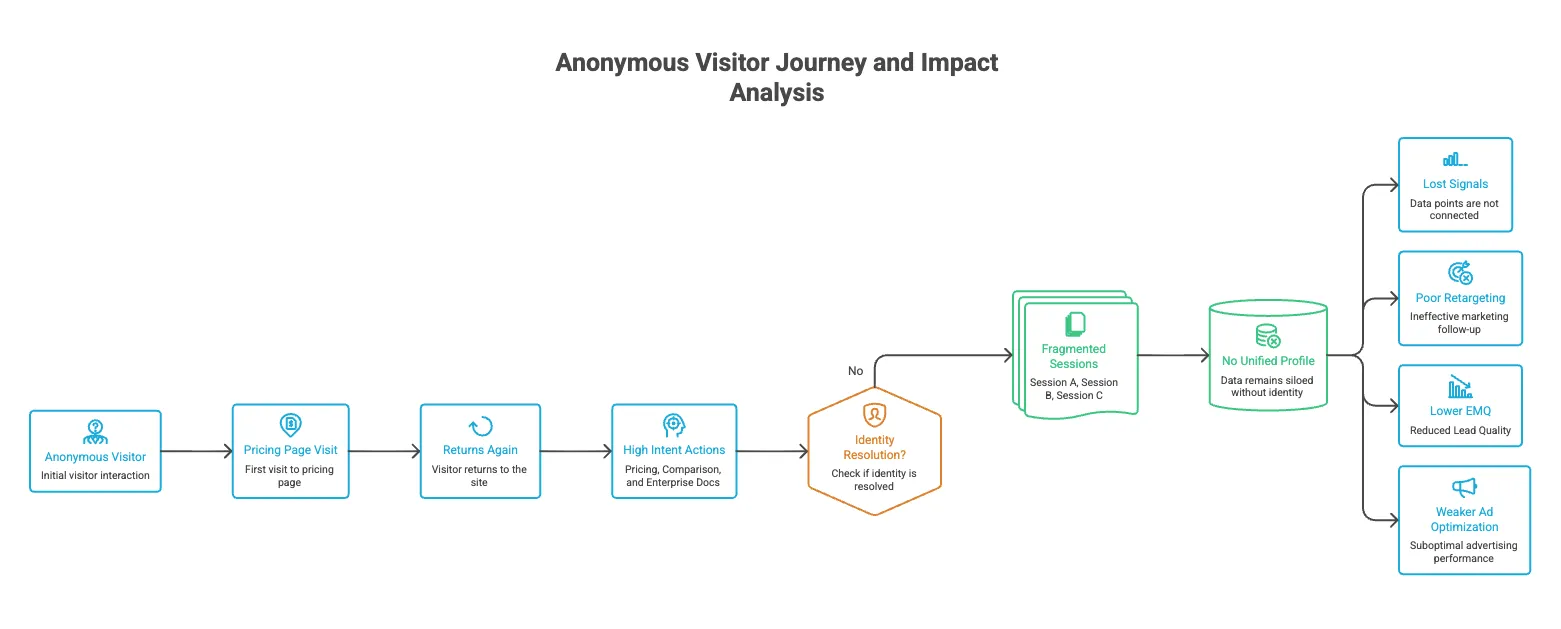
Here’s what stings. The most valuable behavior - the third pricing-page visit, the return trip to your comparison page, the 6-minute read of your enterprise docs - usually happens while the person is still anonymous.
Those are your hottest signals. And they’re sitting in a pile of disconnected sessions that never get tied to a person or sent anywhere useful.
Your Ad Platforms Learn From Incomplete Data
This is where it starts costing real money. Meta and Google don’t optimize on your dashboard - they optimize on the signals you send them.
As Meta explains, “The more conversion events you share with Meta, the better our systems can learn who is likely to take valuable actions.”
Feed the platform only a final “customer created” weeks after the fact, and the algorithm is basically learning from the last page of a book. It never saw the pattern that led there, so it can’t go find more people who match it.
The less context the platform receives, the fewer patterns it has to learn from when trying to find similar high-intent buyers.
The Anonymous Audience Is Larger Than Your CRM Database
Let’s say your website gets 20,000 visitors a month.
A typical B2B conversion rate might turn only 2–3% into leads. That’s roughly 400–600 contacts entering your CRM.
The remaining 19,400+ visitors stay anonymous.
Now narrow that audience to only the highest-intent behaviors:
- Pricing page visitors
- Case study readers
- Demo page visitors
- Return visitors
If retargeting and activating those anonymous visitors generates even a 5% lift in conversions, the incremental pipeline can easily exceed what most teams gain from optimizing forms or landing pages.
The anonymous audience is the iceberg. And right now most of that iceberg is invisible to your ad platforms.
The opportunity isn’t hidden inside your CRM.
It’s sitting outside it.
Why EMQ, Retargeting, and Lookalikes All Suffer
When the journey is fragmented, three things quietly break:
- EMQ tanks. Meta’s Event Match Quality scores how well your signals match real people (aim for 6+ out of 10). Thin, late, unmatched events keep you stuck in “Poor.”
- Retargeting leaks. You can’t retarget the high-intent anonymous visitor who isn’t tied to a recognizable identity - so they slip away.
- Lookalikes get dumber. A lookalike audience is only as good as the seed. Seed it with “all form fills” and you get more form fills. Seed it with “people who behaved like closers” and you get revenue.
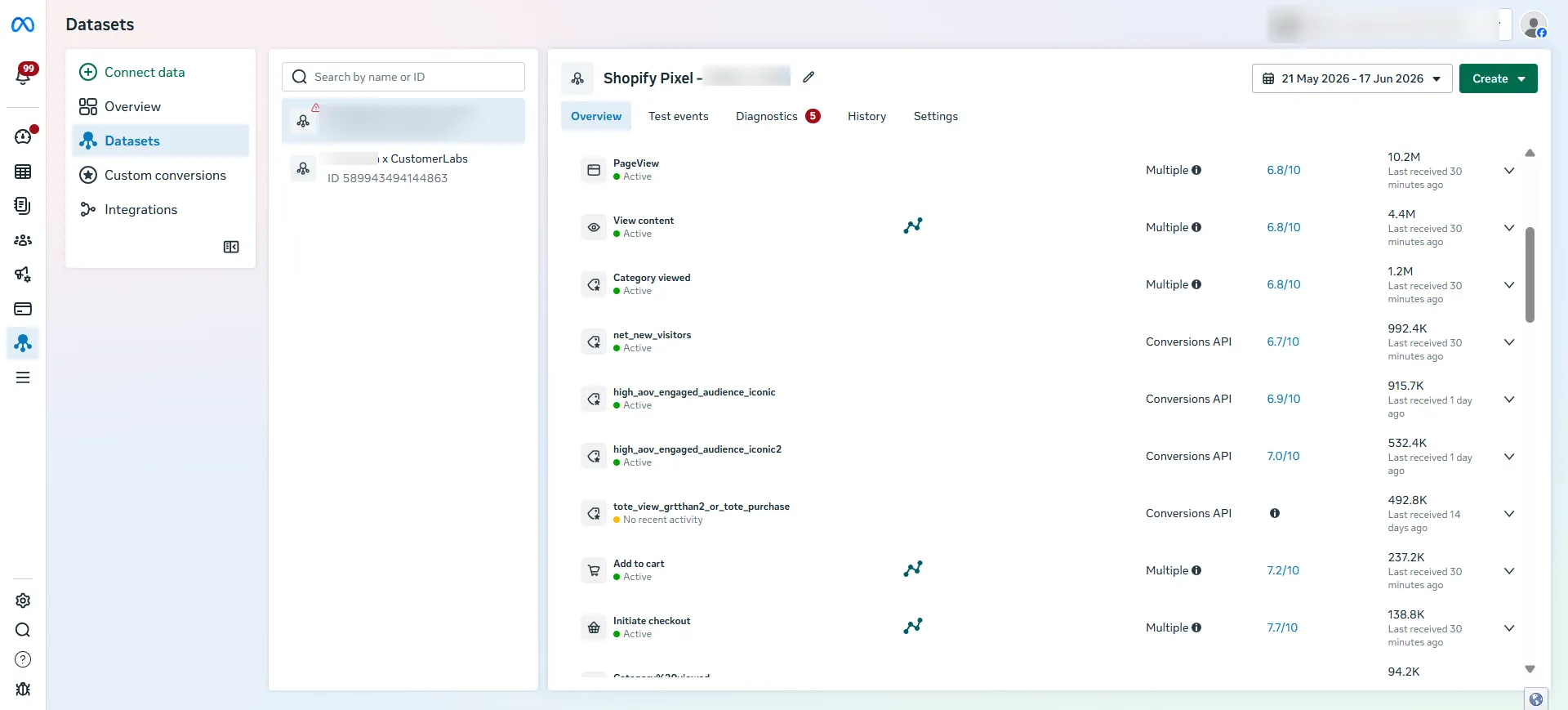
Why Journey-Aware Bidding Becomes Impossible
Here’s the big one, and it’s the reason this matters beyond reporting: journey-aware bidding.
Modern ad platforms don’t just record conversions - they bid in real time on who to show your ad to next, based on the trajectory of behavior you feed them. That’s the whole game now. The algorithm wants to chase people whose path looks like the path of someone about to convert.
But it can’t see a path if all you send is the endpoint. With fragmented anonymous data, every lead looks like a flat, identical dot. The platform can’t tell a three-visit, demo-watching, pricing-page-reading buyer from a four-second bounce. So it bids the same for both - and your budget gets spread across bouncers and buyers alike.
Journey-aware bidding needs the journey. No journey, no journey-aware bidding.
It’s that simple.
Comparison Table: What HubSpot tracks vs. what marketers assume vs. what true anonymous visitor tracking requires
| Dimension | What HubSpot Tracks | What Marketers Assume | What Anonymous Visitor Tracking Actually Requires |
|---|---|---|---|
| Unit of tracking | Sessions & page views | A connected person | A persistent visitor identity |
| Timeline | Mostly after form fill | The full pre-form journey | Every touch, anonymous and known |
| Cross-session | Cookie-based, easily broken | One continuous path | Deterministic + probabilistic stitching |
| Cross-device | Treated as separate visitors | Same human | Merged into one profile |
| Ad readiness | CRM milestones | Rich event signals | Enriched, matched, server-side events |
| Audience size | CRM contacts | Everyone who showed intent | The full anonymous iceberg |
The Real Problem Isn’t Tracking - It’s Identity Resolution
Let me break down the reframe that changes everything once it clicks.
Tracking Activity Is Easy
Logging that a browser did something is trivial. Every analytics tool on earth can do it. HubSpot does it well.
Connecting Activity to a Person Is Hard
The hard part - the genuinely hard part - is saying “all of these scattered sessions, across devices and weeks, are the same human.” That’s identity resolution, and it’s a different discipline entirely.
Why Anonymous Sessions Become Fragmented
A cookie is fragile. Switch from phone to laptop, clear your cache, let Safari’s ITP expire, use private mode - and the same person shatters into five “different” anonymous visitors. Cookie-based tracking can’t help it.
Why HubSpot’s Identity Model Starts After Identification
This is the crux. HubSpot’s identity really kicks in once someone is identified - once there’s an email to anchor to. It retroactively grabs prior sessions on the same cookie, but anything off that cookie, or any signal that has already decayed, doesn’t make it. The model starts at identification. The valuable part of the journey happens before identification.
What True Anonymous Visitor Tracking Actually Requires
If you want the real thing, you need a stack that does five jobs:
- Persistent visitor identity - a durable ID that survives across sessions and devices.
- Session stitching - linking those scattered visits into one path.
- Retroactive merge - when identity is finally revealed, fold all the anonymous history into that person.
- Event enrichment - attach matchable parameters (hashed email, phone, click IDs, browser ID, IP) to every event.
- Server-side activation - push those enriched events to the ad platforms in a way iOS and ad blockers can’t strip.
That’s not a feature you toggle on in a CRM. It’s a layer.
Comparison Table: HubSpot vs. CustomerLabs for anonymous visitor tracking
| Capability | HubSpot | CustomerLabs (1PD Ops) |
|---|---|---|
| Anonymous session logging | ✅ Yes | ✅ Yes |
| Persistent visitor identity across devices | ⚠️ Cookie-bound | ✅ Durable ID |
| Pre-form journey capture | ⚠️ Limited | ✅ Full, server-side |
| Cross-session/device stitching | ❌ No | ✅ Deterministic + probabilistic |
| Retroactive merge to final customer | ⚠️ Same-cookie only | ✅ Full retroactive merge |
| Click ID / attribution recovery | ❌ Often lost | ✅ Preserved & enriched |
| Anonymous → ad-ready signal activation | ❌ No | ✅ Server-side to ad platforms |
How CustomerLabs Fills HubSpot’s Anonymous Visitor Tracking Gap
So this is where CustomerLabs fits - and I want to be clear, it’s not a HubSpot replacement. It sits alongside HubSpot as the first-party data ops (1PD Ops) signal layer.
HubSpot keeps managing your leads. CustomerLabs handles the identity and signal jobs HubSpot was never built for.
Let me show you how those problems addressed above can be sorted out.
Capture the full pre-form journey, server-side
Capture everything, server-side. It collects behavioral data server-side (including via Cloudflare), sets a durable ~1-year first-party cookie, and pulls from all your form sources and CRMs - HubSpot, Salesforce, Pipedrive, and custom sources. The pre-form journey stops leaking out the moment you put this underneath your site.
Stitch scattered sessions into one real person
Turn fragments into people. This is the identity engine. Stitcher uses deterministic + probabilistic matching to merge scattered sessions and duplicates into one profile, retroactively folding anonymous history into the known contact once identity is revealed. The payoff is roughly 2x higher match rates on Meta and Google - which is exactly what lifts EMQ and feeds journey-aware bidding.
Build audiences from behavior, not just CRM status
Build audiences from behavior, not just status. Now that anonymous visitors are real, recognizable people, you can build cohorts that actually move performance: high-intent anonymous segments, return-visitor cohorts, suppression lists (stop paying to chase people who already bought), and closed-deal lookalikes that seed the algorithm with revenue, not noise.
Activate the journey to every ad platform
Activate to where it matters. Enriched, identity-matched events go server-side to Meta CAPI, Google Enhanced Conversions, Google Offline Conversions, LinkedIn, TikTok, Snapchat, and Reddit. Same journey, every platform, told as a story the algorithms can learn from.
Keep it private and compliant
Do it the right way. SHA-256 hashing of PII, compliance with GDPR, DPDP, and CCPA, and PHI scrubbing for sensitive verticals. Better signals and clean governance - not one at the expense of the other.
Put together, that’s the difference between logging that a browser did something and actually following Dana from her first anonymous Meta click to a closed $40K deal - and teaching Meta and Google to go find the next hundred Danas.
The Bottom Line
HubSpot isn’t lying when it says it tracks anonymous visitors. It just means something narrower than you do. It tracks anonymous activity. You need anonymous people - stitched into journeys, enriched into signals, and activated to your ad platforms.
So if your EMQ is stuck, your retargeting feels leaky, and your lookalikes keep finding more tire-kickers, stop blaming the campaigns. The campaigns aren’t the problem. The signal is.
HubSpot manages your leads. A first-party data layer like CustomerLabs tracks the journey that creates them - and hands it to Meta and Google in a language they can actually act on. That’s not another workaround. That’s fixing the signal at the source.