I know what you’re thinking. “Oh, tracking. I do track everything, so what’s the problem?”
Really? Okay, tell me — are you sending all this data to ad platforms?
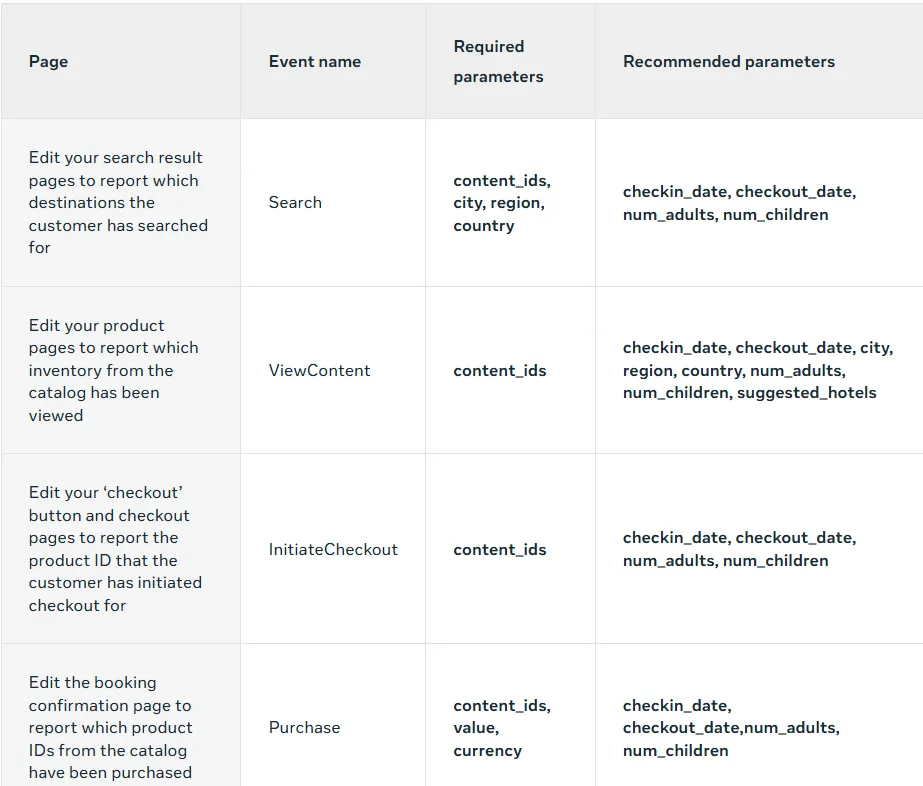
Stay with me, because this is the uncomfortable truth nobody tells performance marketers in the hotel industry:
“This is not 2015 people, it is 2026 and ad platforms run on AI algorithms.”
Let me say that again — AI algorithms. And how do you think AI learns what your business wants? From the data, aka the events, that you send them.
So basically, what you track and send to ad platforms is a lot like the food you put inside your tummy. The algorithms have a grading system that decides where to spend your money. And most of you just track and send without knowing what exactly you are sending.
The formula is simple: you need proper data for precise targeting. And you need proper tracking setup for precise data.
That’s exactly what server-side tracking does — which crappy default browser-side setups cannot measure.
Let’s dig in. First, let’s understand how ad platforms see and grade the data that you send.
(P.S. It is high time you shift your marketing strategy to one based on data, rather than just some random toggles for targeting.)
How Ad Platforms Like Meta and Google Actually See And Grade The Data
Here’s the part most hotel marketers never stop to ask: when you send an event to Meta or Google, what does the algorithm do with it?
It grades it.
Remember the food analogy? This is the part where the algorithm checks whether you sent it a balanced meal or an empty wrapper.
And platforms have been open about what you should send and how. Let’s start with Meta.
Meta scores every advertiser on something called Event Match Quality, or EMQ. Meta rates each event from 0 to 10, or labels it as Poor, OK, Good, or Great. The industry consensus is to aim for 6 or higher — ideally above 8 on your high-value events like Purchase.
Google plays the same game, just with a different name on the jersey.
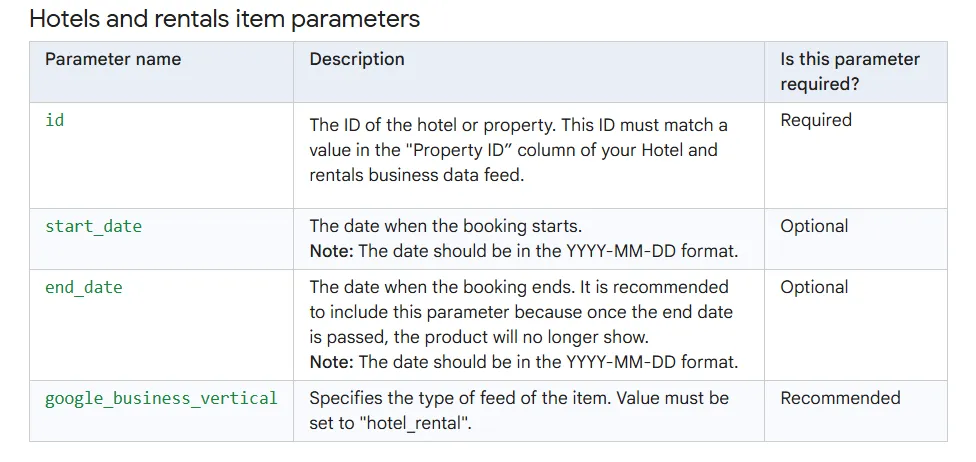
Google calls its version Enhanced Conversions. For hotels specifically, Google goes a step further and asks for travel-specific parameters like the booked hotel ID and the stay dates, which it uses to sharpen both bidding and reporting.
Put them side by side and the demand is almost identical:
| Platform | What it wants from you | How it grades you |
|---|---|---|
| Meta (Conversions API) | Hashed email, phone, name, location, external ID, IP, user agent, fbp/fbc | EMQ score 0–10; aim for 6+ |
| Google (Enhanced Conversions) | Hashed email, name, phone + hotel ID and stay dates | Match rate that fuels AI bidding |
So What Actually Moves That Grade?
First-party data (1P data).
Two different platforms. One identical ask: give me clean first-party data, or I can’t do my job.
Google has already pulled the plug on legacy mechanics. Commission-based bid strategies for Hotel Ads were deprecated as of February 20, 2025, and campaigns running on them didn’t gently downgrade — they stopped serving in the auction. Google’s own recommendation is to move Hotel Ads campaigns onto Target ROAS, Enhanced CPC, or Performance Max for Travel, every one of which leans harder on the conversion data you feed it.
The shift is driven by the phasing out of third-party cookies, with Google transitioning to more durable, privacy-focused strategies.
So the mandate is clear: send rich, matched parameters or watch the algorithm underperform. The trouble is that the standard way hotels collect data makes sending those parameters reliably almost impossible. That’s the gap server-side tracking exists to fill.
Why Server-Side Tracking Is Crucial for Hotels
A traditional browser pixel can only send what the browser still has — and browsers have become hostile territory.
Safari’s Intelligent Tracking Prevention caps tracking cookies at 7 days, ad blockers (used by 30–40% of users) strip third-party scripts, and iOS link protections break click attribution before the pixel even fires.
Note: even native CAPI setups still cannot do the job.
Server-side tracking moves the collection point from the fragile browser to your own server. The event looks like a first-party request, so ad blockers rarely touch it, and you can reliably attach the full parameter set — hashed email, phone, hotel ID, stay dates — that Meta and Google are grading you on. Businesses that make the switch commonly recover 20–40% of conversions that client-side tracking was silently dropping.
Here’s the catch that trips up most hotels, though: simply switching on a booking engine’s “native” tracking integration doesn’t close the gap. To see why, you have to follow what actually happens at the single most important moment in the hotel journey — the booking handoff.
Native Tracking Gap: Cross-Domain Tracking and Session Breakage
Most hotels don’t take the booking on their own website. The guest researches on yourhotel.com, clicks “Book Now,” and gets handed off to a third-party booking engine on a completely different domain — SynXis, Cloudbeds, RoomRaccoon, etc.
That handoff is where attribution breaks. When a user crosses from Domain A to Domain B, analytics drops the source and medium, and the session is logged as (direct)/(none), as if the guest appeared out of nowhere.
The Google click identifier (gclid) that ties a booking back to a specific ad doesn’t survive the redirect either. The result: attribution loss gaps of 40–70% when you compare booking-engine revenue against what the ad platforms report.
Native booking-engine integrations often place a conversion tag on the confirmation page, but they don’t bridge the click identifier back across the domain split. So the pixel fires on the wrong domain, too late, with the identity context gone. The booking happened, but the ad platform’s AI never learns which click earned it. Multiply that across thousands of room nights and you’re training Meta and Google on a fraction of the truth.
As damaging as that single broken handoff is, it’s only half the story. Stretch it across the way people actually shop for travel, and a leak becomes a flood.
The Bigger Problem: Long Conversion Cycles
A hotel purchase isn’t an impulse buy. Research shows a hotel buyer takes around 89 days and visits dozens of sites — touching hundreds of micro-moments — before they confirm. For travel-package providers bundling flights, stays, and experiences, that consideration window stretches even further.
Compare that to Safari’s 7-day cookie lifespan. The math is brutal: a guest who discovers you in week one and books in week twelve is, as far as client-side tracking is concerned, a brand-new stranger with no history.
The ad that inspired the dream gets zero credit. The platform’s AI never connects the first touch to the booking, so it can’t learn what actually drives long-cycle conversions — and it deprioritizes the very campaigns doing the early, top-of-funnel work.
Long conversion cycles are precisely the conditions under which browser-based tracking fails worst. So the question becomes practical: how do you actually keep a guest’s journey intact across a different domain and across twelve weeks? That’s exactly what a server-side layer is built to do — and it’s easiest to understand by walking through a real booking.

How Server-Side Tracking Closes the Data Gap
So how do you actually feed the algorithm what it’s been asking for?
You stop relying on the browser to remember things. Because it won’t.
A browser cookie is a sticky note. The browser throws it away in a week, sometimes sooner. A server-side layer like CustomerLabs is different: it captures the guest’s identifiers and event data and stores them on your server, not in their browser. So the journey stays in one piece, even when the guest jumps to another domain, and even when they take two months to book.
The easiest way to see the difference is to follow one guest, both ways.
Scenario 1: The guest who jumps to your booking engine
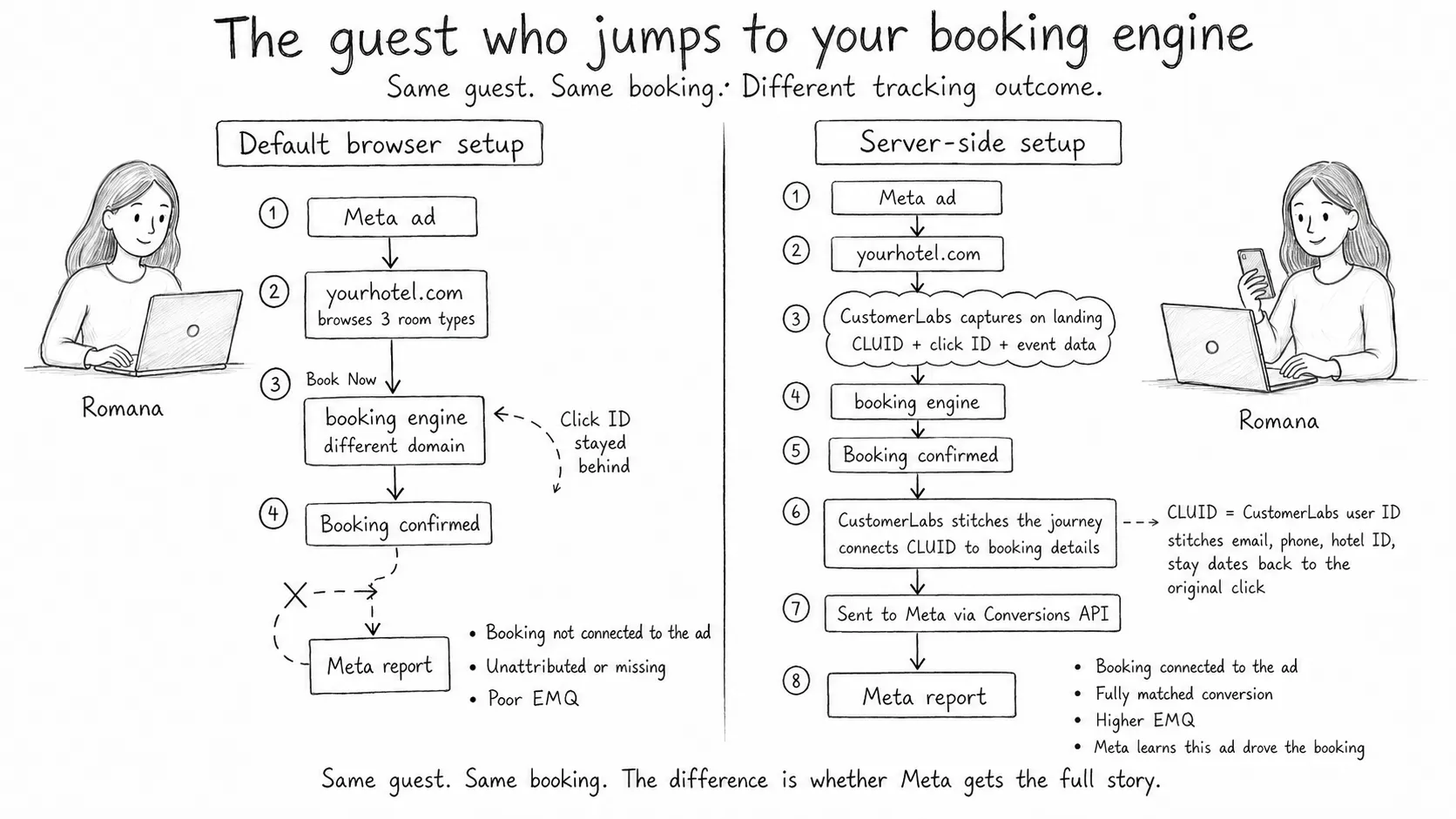
Meet Romana. She clicks a Meta ad for your beach resort, lands on yourhotel.com, and browses three room types.
With the default browser setup: Romana clicks “Book Now” and gets sent to your booking engine — a different domain. The Meta click ID and everything Meta knew about her session stayed behind on yourhotel.com. She books.
The booking engine’s pixel fires on its own confirmation page, but it has no idea she came from a Meta ad. So in Meta’s report, that booking either doesn’t show up at all or shows up as “unattributed.” Your EMQ stays Poor, because no customer info ever got matched.
With the server-side setup: The second Romana arrives from the ad, her click ID and event data are captured on the server. When she books on the other domain, tools like CustomerLabs use identity resolution to connect that confirmation — her hashed email, phone, the hotel ID, the stay dates — back to the original Meta click, and send the whole thing to the Conversions API.
Now Meta sees a fully matched conversion. EMQ climbs. And the algorithm finally learns: this ad earned this booking.
Same guest. Same booking. The only thing that changed is whether the platform ever found out it happened.
Scenario 2: The guest who takes two months to book
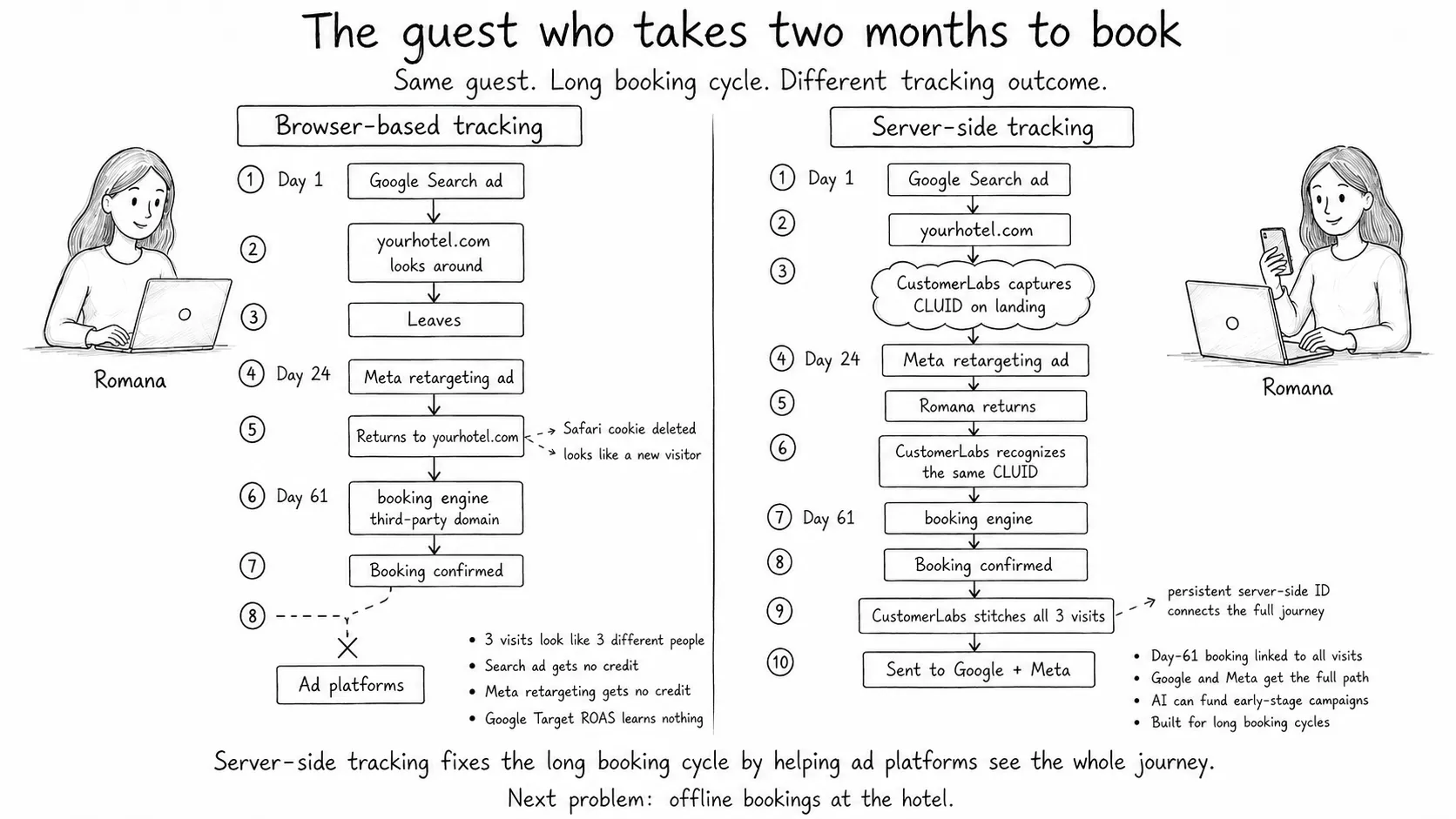
Now stretch Romana’s journey across a real travel timeline.
- Day 1: She finds you through a Google Search ad, looks around, and leaves.
- Day 24: Safari has already deleted her cookie. She comes back through a Meta retargeting ad — but to browser-based tracking, she looks like a brand-new stranger.
- Day 61: She finally books on the third-party engine.
With browser-based tracking, those three visits are three different people. The Search ad that started it all gets zero credit. The retargeting ad that brought her back gets zero credit. And Google’s Target ROAS bidding learns nothing about what a real, slow-cooking hotel booking actually looks like.
With server-side tracking, Romana is recognized by a persistent server-side ID every time she returns. The Day-61 booking gets connected back across all three visits and reported to both Google and Meta. The AI finally sees the full path and starts funding the early-stage campaigns it used to starve.
That’s the whole job of the server-side layer: it hands the platforms the data they were asking for all along — complete, matched, and built to last — in exactly the two spots where the default setup falls apart. The cross-domain jump, and the long booking cycle.
But there’s one more kind of booking it rescues: the kind that never happens on your website at all.
Offline bookings — the ones that close at the hotel — may or may not have the influence of your campaigns. To figure that out, you need to track and stitch both online and offline actions via offline conversion tracking.
Offline Conversion Tracking for Hotels with the Long Conversion Cycle
Here’s an uncomfortable truth about hotel revenue: a huge chunk of it never touches your website’s “Book Now” button at all.
It closes:
- over the phone with the call center
- when a sales rep follows up on a package inquiry
- inside a corporate-rate agreement, or
- as an upsell someone confirms in the PMS days after the ad was clicked
And every single one of those bookings? Stays invisible to your pixel. (Uhh — your default CAPI cannot do this either.)
Picture a corporate travel manager. They click your Google ad, fill out a “request a group rate” form, and 45 days later close a 40-room block over the phone. To the pixel, that ad drove a form fill — a single, lonely form fill. The actual revenue, the part that pays your salary, simply doesn’t exist as far as Meta and Google are concerned.
So how do you actually drag that revenue back into the light? With offline conversion tracking. Like this.
Here’s how the loop gets closed
Every ad click that lands on your site gets captured and tied to a real person — not a cookie that evaporates the moment Safari feels like it, but a durable identity that survives the 45-day gap between “filled out a form” and “signed the contract.”
That identity sits and waits. Then, when the booking finally closes in the CRM or on a call-center note, that closed-won event gets pulled from your system, stitched back to the original click, and sent server-side straight to Meta and Google as a real, revenue-attached conversion.
No pixel required. No manual CSV uploads at the end of the month. The booking that closed over the phone 45 days later finally gets stitched back to the campaign that earned it.
That’s the feedback loop. And the loop is the part most hotel marketers never finish.
Because capturing the booking is only half of it. The other half is activating that data — pushing it back into Meta and Google so the platforms can actually use it.
Here’s what changes the moment that data starts flowing back. The platform stops optimizing for the cheap, fast form fills it could see and starts hunting for the buyers who actually close.
It bids harder for the next corporate travel manager and ignores the tire-kickers. Cleaner signal feeds smarter optimization, smarter optimization lowers your real cost per booking — not your cost per form fill — and the same budget starts reaching more of the right travelers.
And once that complete, durable data is flowing both directions, accurate reporting turns out to be just the beginning of what it unlocks.
Set up server-side tracking and upgrade your entire marketing stack.
Use Cases for Marketers in the Hotel Industry
Fixing attribution is the foundation, but it’s not the finish line. Once a clean, identity-rich data layer is flowing server-side, the same signal can be activated across every channel a hotel markets on. Here’s what that unlocks in practice.
Smarter retargeting that doesn’t waste spend
Browser-based retargeting audiences decay fast — the moment Safari expires a cookie, that prospect silently falls out of your retargeting pool. Server-side audiences are built on durable first-party identifiers like email and phone, so they stay accurate and refresh continuously by setting up Google Data Manager API.
In practice, that means a guest who viewed your suite category but didn’t book stays in your “abandoned high-value rooms” audience for the full 60-day consideration window — not just the seven days a cookie survives — so you’re still in front of her when she’s ready to commit.
Exclusion audiences that stop you paying twice
This is the flip side of retargeting, and it’s where hotels quietly burn their budgets. The moment a guest completes a booking, server-side data can push them into an exclusion list across Meta and Google so they immediately drop out of acquisition campaigns.
Without it, you keep paying to show “Book your stay” ads to someone who already booked — and worse, you annoy a guest who’s now mid-trip. Tie the exclusion to the confirmed booking event and that spend is redirected to fresh prospects automatically.
Email-list and CRM audiences for lookalikes and direct campaigns
Your CRM is full of past guests, loyalty members, and corporate contacts — your highest-converting segments. Server-side activation lets you sync those lists as matched audiences for direct campaigns (a win-back offer to last summer’s guests) and as seed audiences for lookalikes (find more travelers like your repeat bookers).
Because the match is built on hashed first-party identifiers, match rates are far higher than uploading a raw list — which means bigger, more accurate audiences for the algorithm to work with.
WhatsApp and messaging marketing triggered by real behavior
Messaging is now a primary booking channel for many hotels, and server-side signals make it intelligent rather than blast-everyone.
Because booking and intent events are captured the moment they happen, you can trigger WhatsApp outreach off real behavior — a pre-arrival upsell message to a confirmed guest, a gentle nudge to someone who started a booking but didn’t finish, or a check-in offer timed to the stay dates. The messaging is driven by what the guest actually did, not a guess.
Send clean data to GA4 for reporting you can trust
Server-side events don’t only go to ad platforms — they can be pushed into GA4 too, so your analytics finally reconcile with your ad reports instead of telling three different stories.
For a revenue manager, that’s the difference between a GA4 dashboard that undercounts bookings by 40% and one that matches what actually closed in the PMS.
One source of truth across every platform
Pulling it together: a single server-side data layer feeds Meta, Google, GA4, and your messaging tools the same matched, durable conversions.
No more reconciling three conversion numbers, no more campaigns optimizing against blind spots — every platform learns from the same complete picture of who booked and why.
Conclusion
The takeaway is simple. Meta and Google are grading your data, their AI spends your budget based on that grade, and the native hotel setup leaks the exact signals they want — at the cross-domain handoff and across an 89-day booking cycle that no 7-day cookie can survive.
Server-side tracking is how hotels feed the machine what it’s asking for: complete, matched, durable conversions, plus the offline events that close the loop on long cycles.
If your Meta EMQ is sitting in the “Poor” zone or your booking-engine revenue never matches your ad reports, that gap is costing you efficiency every single day. See how CustomerLabs sets up server-side tracking for your hotel and start sending the platforms the data their algorithms have been waiting for.