If you run ads to sell vehicles, your biggest problem is real conversion: the actual sale happens offline, and your ad platforms have no idea it occurred. This completely breaks automotive campaigns.
Think about the typical automotive ads.
A customer clicks your ad, fills out a form, and then weeks go by before they finally walk into the showroom and sign the paperwork. By the time that sale closes inside your Dealership Management System (DMS), the original digital footprint — like the Google or Meta click ID — is completely lost. Your DMS wasn’t built to store tracking codes, so the ad platforms never get the memo that the ad actually worked.
The real “aha moment” happens when you stop feeding the algorithm cheap form-fills and start feeding it actual showroom sales data.
Right now, most dealers are optimizing for leads that might never buy. But when you use a first-party data layer to bridge that gap and pipe real sales back to Meta and Google, the platforms stop guessing. Instead of hunting for people who just like filling out forms, the algorithm starts hunting for people who actually buy cars.
That’s why automotive offline conversion tracking is broken for most dealers — and why a first-party data layer is the fix.
If Your Ads Are “Converting” Online, Why Isn’t the Sales Floor Feeling It?
Every dollar you spend advertising vehicles has one real job: selling a car. Not collecting a form or ringing the phone — selling a car.
But if you’re an automotive advertiser, you’ve probably noticed the numbers never line up. Meta and Google claim a stack of conversions. Yet the sales floor tells a different story, and nobody can confidently say which ad actually put someone in a vehicle.
So budget decisions turn into guesses. You can’t tell your best-performing campaign from your worst, because the thing you actually sell — the car — never shows up as a conversion the platforms recognize. You’re optimizing toward form fills and hoping cars follow.
That’s the problem. Now let’s look at why it happens.
Why Does This Attribution Gap Happen?
It comes down to two unique realities of buying a car that make automotive advertising incredibly painful:
-
The click is online, but the cash changes hands offline. Nobody buys a $40,000 truck with a credit card from a Facebook ad. They research online, browse your inventory, and then drive to the dealership to sign the paperwork in person. Because Meta and Google are built to track browser actions, the moment that actually matters most happens completely out of their view.
-
The car-buying journey is a marathon. According to Cox Automotive, the average buyer spends about 14 hours actively shopping, but they spread that time across weeks, sometimes months, swapping between their phones and laptops. A customer might click your ad in March, keep thinking about it, and finally walk into the showroom in May.
When you combine a long timeline with an offline purchase, you get confusion. To accurately count that sale, the ad platform needs the dealership to send the showroom data back to them, tied directly to the original click ID.
That is why offline conversion tracking for the automotive industry is so vital — but it relies on one incredibly fragile piece of digital data surviving that entire multi-week trip.
Why Can’t a DMS Store Ad Click IDs for Attribution?
The click ID is the digital breadcrumb trail that ties a buyer back to an ad. Google calls it a gclid, Meta calls it an fbclid, and TikTok calls it a ttclid. If you send the showroom sale back to the platform with that ID attached, the algorithm instantly learns: “My ad sold that car.”
Without that ID, there is no match, no learning, and no optimization.
In the automotive world, that digital trail snaps in three specific places before the customer ever buys:
-
The lead forms drop it: When a customer fills out a test-drive or finance form, the form captures their name, email, and phone number — but it completely ignores the tracking code sitting in the browser URL. The lead lands in your CRM with zero memory of the ad that brought them there.
-
Privacy updates strip it: Modern browser privacy protections aggressively scrub these tracking parameters from URLs, especially if a user is browsing privately or clicking links from text messages. Since most car research happens on mobile, a huge chunk of your high-intent traffic arrives with the trail already erased.
-
The DMS can’t store it: This is the real killer. Your Dealership Management System — whether it’s CDK, Reynolds & Reynolds, or Dealertrack — was built to handle inventory, financing, and legal paperwork. It tracks the buyer, the VIN, and the margins, not a string of code from a Google ad. It was never designed to hold web data in a deal jacket.
That is the true root cause: your DMS holds the ultimate proof of the sale, but it has no idea where the buyer actually came from. To fix offline conversion tracking, you can’t rely on the DMS alone. You need a data layer that saves that click ID on day one and pairs it back up with the sale weeks later.
How Do Offline Conversion Tracking Setups Preserve the Click ID?
The solution is actually straightforward in theory: you just need to keep that click ID alive from the moment a user lands on your site, and then match it to the sale when the deal closes on the showroom floor.
To make this hold together, you need four things:
-
Catch it early (server-side): Grab the click ID the exact second a user lands on your site. By capturing it on the server level rather than relying entirely on the browser, you bypass the privacy blocks that try to scrub the tracking code.
-
Lock it to the lead: The moment they fill out a form, attach that click ID directly to their customer profile in your database. This ensures the digital footprint travels alongside their name, email, and phone number.
-
Match the offline sale and send: When the deal officially closes weeks later, your data layer automatically pairs that physical showroom sale back up with the stored click ID, instantly pushing the conversion out to Meta’s Conversions API and Google Ads.
-
Build the ultimate audiences: Once the ad platforms know who actually bought a car, you can stop wasting the budget showing ads to people who already have a new vehicle in their driveway. You can tell the algorithm to build lookalikes off actual purchasers and suppress people who already bought.
Pushing data into Google or Meta isn’t the breakthrough here — the ad platforms have well-documented pipelines for that (including for tricky cases like Google’s WBRAID/GBRAID). The real battle in automotive is keeping that fragile click ID alive across a multi-week, mobile-first, offline journey.
That’s a data problem, and it needs a data layer.
The Solution: Closing the Loop with CustomerLabs First-Party Data
This is where a dedicated first-party data layer does the heavy lifting that a browser pixel and a DMS simply can’t. CustomerLabs steps in as the foundational data infrastructure for your dealership, handling the entire tracking process from the first click to the final handshake.
It captures those click IDs on the server-side at first touch, locking them into a secure first-party profile so they survive the long buying cycle. But it doesn’t just stop at tracking codes. It enriches those profiles by capturing the high-intent behavioral actions that actually matter to a dealership — like test-drive enquiries, finance applications, service bookings, call-button clicks, WhatsApp enquiries, and views of specific vehicle models.
Then, the moment you hand it a completed sale, it matches that offline conversion back to the original click and sends it to Meta, Google, and TikTok, and syncs your real buyers back as audiences.
Let’s be completely honest about the DMS: most platforms are closed systems that make integrations notoriously difficult, and they don’t hold click IDs anyway. CustomerLabs doesn’t need to force its way inside your DMS. Instead, you simply pull your completed sales data from wherever it lives — your CRM, a daily sales export, or a webhook — and it handles the missing click ID that the DMS never had.
Why do you need a first-party layer instead of just relying on standard platform pixels? Because browser pixels live in the browser — the exact place where iOS updates, privacy blocks, and long car-buying journeys break the trail. Preserving the click ID on the server is the only way it lasts long enough to meet the offline sale.
What Changes When Automotive Advertisers Get This Right?
Once the ad platforms can finally see which clicks turned into actual vehicle sales, the entire game shifts. The algorithms stop chasing professional form-fillers and start hunting for real buyers.
The data backs this up. Meta’s own research shows that advertisers who pipe their data through the Conversions API see an average 13% improvement in cost per result (PCG Digital). Real-world dealers who fix their offline conversion tracking commonly report 20% to 30% gains in overall cost efficiency (vendor-reported, so treat it as directional — Demand Local).
To see what this actually looks like in practice, consider a typical mid-sized dealership:
Let’s say a store spends a steady budget on Meta and Google. Their cost per lead sits around $90, and the sales floor is constantly grumbling that the leads are junk.
Without touching their ad budget, changing their creatives, or adjusting their targeting, the dealer implements a first-party data layer. They start preserving the click ID and feeding completed showroom sales back to the platforms. Over a couple of months, the algorithms re-learn what a real buyer looks like. The junk leads thin out, the cost per lead drops into the $30s, and the actual gross profit tied to those channels climbs.
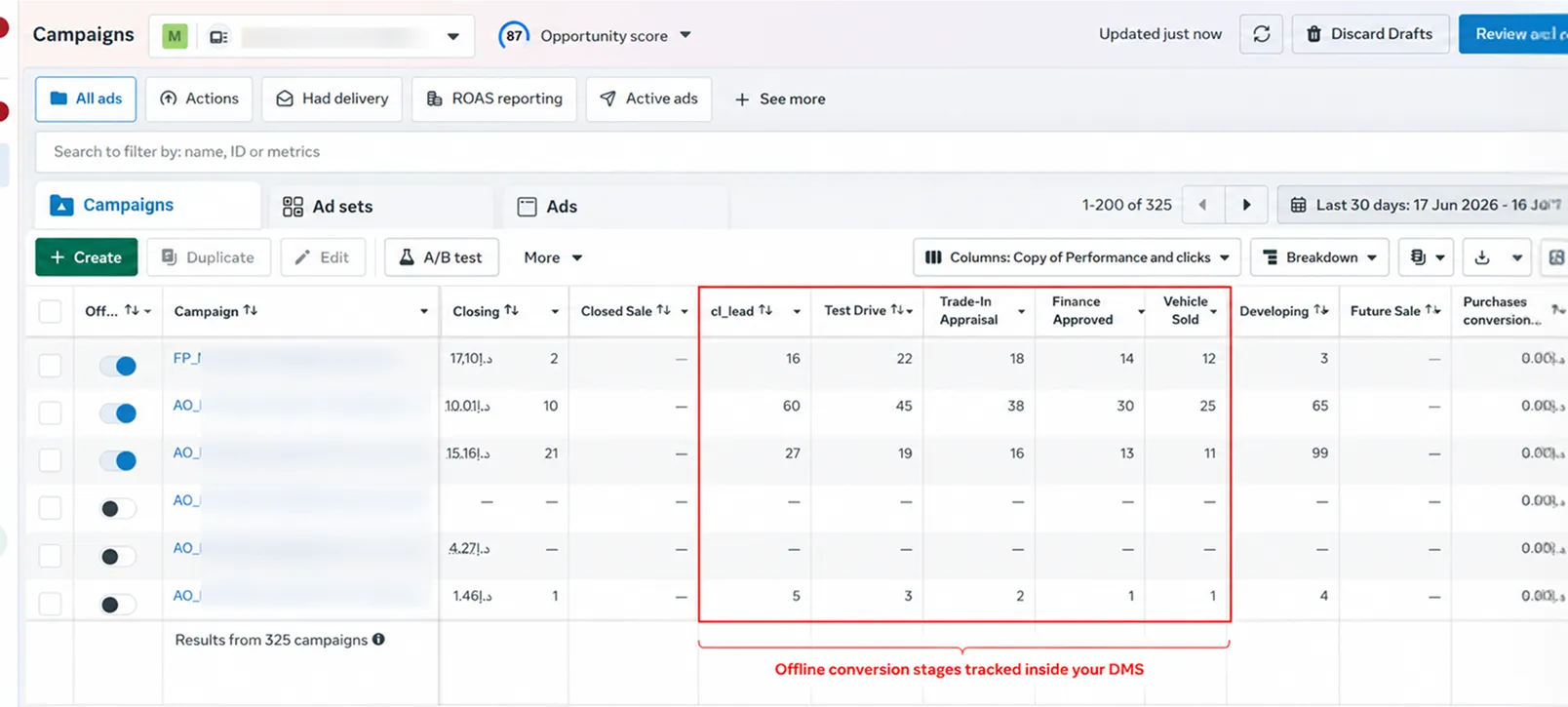
The numbers are illustrative; the mechanism is the point. The campaigns didn’t change, and the budget didn’t change. The offline data signal changed — and every algorithm finally learned what a vehicle buyer looks like.
Final Verdict
If you advertise vehicles, your real conversion is the offline sale — and right now, your ad platforms can’t see any of them. That isn’t because the platforms are broken; it’s because the click ID dies before the sale and the DMS was never built to keep it.
Stop trying to fix your campaigns when the real problem is your data signal. Preserve the click ID with a first-party data layer, match it to the sale when the deal closes, and send that offline conversion to Meta, Google, and TikTok. That’s how automotive offline conversion tracking finally teaches every platform who your buyers really are.